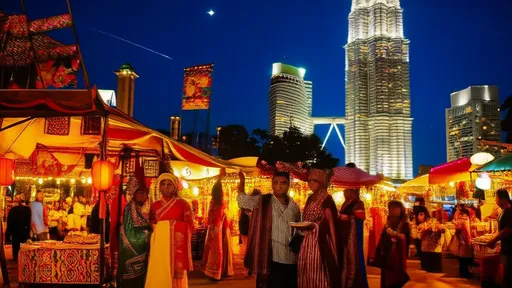
As dusk descends upon Kuala Lumpur, the Petronas Twin Towers begin their nightly transformation. What was by day a marvel of modern engineering and soaring ambition becomes by night something else entirely—a luminous beacon at the heart of a living, breathing cultural mosaic. The towers, in their radiant glow, do not stand as a monument to isolation but as a central stage for a profound and ongoing human story. This is not merely a spectacle of light and architecture; it is the pulsating core of a multicultural nexus, a place where the concept of a global village ceases to be an abstract ideal and becomes a tangible, nightly reality.
The towers themselves are a testament to a nation's bold stride onto the world stage, a symbol of progress and economic vitality. Yet, their significance is profoundly deepened by their context. They are rooted not in a homogenous landscape but in the incredibly diverse soil of Malaysia. Standing at their base, one is immediately swept into a current of humanity that is stunning in its variety. The air is thick with a symphony of languages—the melodic tones of Bahasa Malaysia, the sharp cadences of Mandarin, the rounded vowels of Tamil, and the familiar cosmopolitan hum of English, all woven together with a dozen other tongues from across the globe. This is the first and most immediate evidence of the melting pot. It is a place where the world, quite literally, meets.
As night deepens, the plaza surrounding the towers transforms into a vast, open-air social canvas. Here, the performance of multicultural coexistence is enacted not as policy, but as instinct. Families, friends, and solitary observers congregate. A group of local Malay students, dressed in contemporary fashion, laugh and take selfies against the glittering backdrop. Nearby, a Chinese-Malaysian family explains the history of the towers to their elderly grandparents, their conversation a fluid mix of dialects. European tourists consult maps next to Indian-Malaysian couples enjoying a quiet evening stroll. There are no barriers, no segregated zones. The shared awe for the structure above them creates a common ground, a silent agreement of shared space and mutual appreciation. The grandeur of the human-made spectacle seems to diminish the perceived grandeur of human differences.
The true magic, however, radiates outward from the towers' immediate vicinity into the vibrant arteries of the city. The iconic silhouette acts as a compass needle, pointing the way to experiences that define Kuala Lumpur's cultural soul. A short walk leads to the bustling streets of Bukit Bintang, where the scent of sizzling satay from a Malay hawker stall competes with the aromatic allure of char kway teow from a Chinese vendor. The rhythmic beats from a traditional Malay music store might drift into a café playing modern K-pop. In the nearby precincts of KLCC, luxury shopping malls stand beside centuries-old mosques, their ancient prayers undisturbed by the modern hustle. This seamless juxtaposition is not jarring; it is the city's defining characteristic. The towers are the constant, the luminous anchor around which this beautiful chaos orbits.
This environment naturally fosters a unique cultural fluency among those who inhabit and visit it. The nightly congregation under the towers is a masterclass in nonverbal communication and cultural exchange. A smile exchanged between strangers over a spilled drink, the unspoken coordination of a crowd making way for a photograph, the shared nod of appreciation as the light show begins—these micro-interactions are the glue of the multicultural fabric. People learn not just to tolerate difference, but to navigate it with a quiet grace. They sample each other's foods, observe each other's customs, and in doing so, they participate in an unwritten but deeply felt social contract. The space becomes a classroom without walls, teaching lessons of empathy and connection that are far more powerful than any textbook dogma.
Furthermore, the Petronas Twin Towers at night become a powerful symbol of a modern, global identity. For the younger generation of Malaysians, they represent a future that is both proudly Malaysian and confidently international. They are a source of immense national pride, yet their design and ambition speak a global language. This duality is reflective of the identity of many who gather here: individuals who can code-switch between cultures, who feel equally at home in a traditional kampung (village) setting and in the hyper-modern landscape of the city. The towers validate this complex identity, proving that one can honor tradition while embracing progress, and that cultural depth is not diluted by global connection but is instead enriched by it.
In conclusion, to reduce the Petronas Twin Towers to a mere architectural feat is to miss their deepest purpose. When illuminated against the night sky, they cease to be simply steel, glass, and concrete. They become a lighthouse, not for ships, but for people. They cast a light that reveals not just the physical beauty of a city, but the profound beauty of its people's collective spirit. The real spectacle is not the symphony of lights dancing up the facades, but the symphony of cultures dancing below—a dynamic, ever-evolving performance of unity in diversity. It is a nightly reminder that our greatest human constructions are not our buildings, but our communities. In the shadow of these giants, under the warm glow of their lights, the world offers a quiet, powerful lesson in how to live together.
By /Sep 3, 2025
By /Sep 3, 2025

By /Sep 3, 2025

By /Sep 3, 2025
By /Sep 3, 2025
By /Sep 3, 2025
By /Sep 3, 2025
By /Sep 3, 2025
By /Sep 3, 2025
By /Sep 3, 2025

By /Sep 3, 2025

By /Sep 3, 2025

By /Sep 3, 2025

By /Sep 3, 2025

By /Sep 3, 2025

By /Sep 3, 2025

By /Sep 3, 2025

By /Sep 3, 2025

By /Sep 3, 2025

By /Sep 3, 2025
