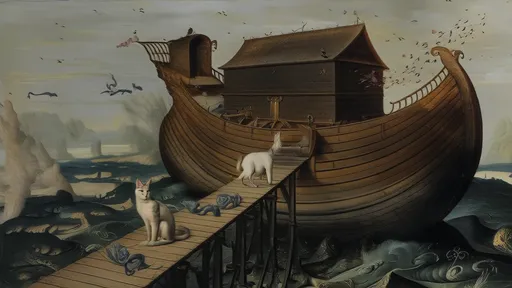
In the rich tapestry of feline lore, few stories are as enchanting or as deeply woven into cultural mythology as the origin of the Turkish Van cat. This majestic breed, known for its striking white coat and captivating heterochromatic eyes, carries with it a legend as old as time itself—a tale set aboard the most famous vessel in biblical history: Noah's Ark.
According to the enduring myth, as Noah’s Ark floated upon the endless waters of the Great Flood, a pair of cats—ancestors to what we now know as the Turkish Van—found themselves among the saved. The story goes that as the ark journeyed across the submerged world, a mouse, also seeking refuge, began to gnaw at the wooden hull, threatening the very integrity of the ship and all life within. Noah, distressed by this new peril, prayed to God for a solution. In answer to his prayers, God caused the lion to sneeze, and from its nostrils emerged a spirited, agile cat. This newly created feline swiftly dispatched the mouse, plugging the leak and saving the ark from certain disaster.
This divine intervention, however, was just the beginning of the Turkish Van's distinctive story. The legend further narrates that as the waters eventually receded and the ark came to rest on the slopes of Mount Ararat, the cats disembarked and made their way to the surrounding region, particularly around Lake Van in eastern Anatolia. It is here that they acquired their most famous trait. As they swam in the cool, mineral-rich waters of the lake, only their heads remained dry. God, or some versions say an angel, reached down and blessed them, touching their heads and tails, leaving behind the beautiful russet or amber markings that contrast so vividly against their snow-white bodies. This is why the breed is often called the "swimming cat," a creature not only unafraid of water but seemingly drawn to it, a living testament to its legendary past.
The physical characteristics of the Turkish Van are thus directly tied to its mythical origin. The classic color pattern—a pure white body with colored markings restricted to the head and tail—is poetically referred to as the "Van pattern." This is not merely a aesthetic feature but a badge of honor, a divine signature from its creation story. Their strong, muscular build and water-resistant, chalky single coat are seen as adaptations from their time navigating the floodwaters and the lake they later called home. Their love for water is exceptionally rare in the feline world, setting them apart as a living legend.
Beyond the biblical narrative, the breed's history is deeply entrenched in the rugged, beautiful landscape of the Van region. For centuries, these cats were not just pets but working members of the community and cherished companions. They were known locally as Van Kedisi. Their value was such that they were rarely sold but often given as precious gifts, signifying deep respect and friendship. Their image has been found on ancient jewelry and artifacts, indicating their revered status for millennia. They are a national treasure in Turkey, a symbol of resilience and beauty, protected and celebrated for their unique heritage.
The journey of the Turkish Van from a local legend to a recognized international breed is a story of modern discovery. While they had been known and loved in their homeland for centuries, they were largely unknown to the Western world until the mid-20th century. In 1955, two British photographers, Laura Lushington and Sonia Halliday, on assignment in Turkey, were given a pair of these captivating kittens. They were astonished by the cats' dog-like behavior, intelligence, and most notably, their fascination with water. Lushington began a dedicated breeding program, and the breed was officially recognized in Great Britain in 1969. The name Turkish Van was chosen to distinguish it from the Turkish Angora and to cement its geographical roots.
Today, the Turkish Van is admired worldwide for its playful, energetic, and affectionate personality. They form powerful bonds with their human families, often following them from room to room and engaging in games of fetch. Their intelligence is remarkable, and they are known for their problem-solving skills and sometimes mischievous antics. Yet, they retain that ancient, legendary connection to water. Many owners report their Vans joyfully playing in sinks, paddling in bathtubs, or even attempting to join them in the shower, a charming and direct link to the myth of their blessed, watery origin.
The legend of the Turkish Van is more than a simple folktale; it is a foundational myth that explains the very essence of the breed. It provides a divine reason for its unique appearance, its unusual behavior, and its profound connection to a specific part of the world. This story, passed down through generations, elevates the Turkish Van from a mere animal to a creature of destiny, a blessed survivor whose ancestors played a pivotal role in one of history's greatest stories of salvation. It is a narrative that continues to capture the imagination, ensuring that every Turkish Van cat carries not just a beautiful coat, but the weight and wonder of a timeless legend.
By /Aug 20, 2025
By /Aug 20, 2025
By /Aug 20, 2025
By /Aug 20, 2025
By /Aug 20, 2025
By /Aug 20, 2025

By /Aug 20, 2025
By /Aug 20, 2025
By /Aug 20, 2025
By /Aug 20, 2025
By /Aug 20, 2025
By /Aug 20, 2025
By /Aug 20, 2025
By /Aug 20, 2025
By /Aug 20, 2025
By /Aug 20, 2025
By /Aug 20, 2025
By /Aug 20, 2025
By /Aug 20, 2025
By /Aug 20, 2025
