The history of the Rottweiler is a journey that begins in the shadow of the Roman legions, a tale woven into the fabric of ancient empires and the practical needs of conquest. This is not merely the story of a breed's development, but a chronicle of a working partnership between man and dog that has endured for millennia, adapting to the collapse of civilizations and the shifting demands of human society.
To trace the origins of the Rottweiler, one must travel back to the first and second centuries AD, to the vast and formidable military machine of the Roman Empire. As the legions marched northward to conquer the Germanic territories, they did not travel alone. Their supply trains, essential for feeding a massive army on the move, were accompanied by robust, mastiff-type dogs. These canine companions were the indispensable ancestors of the Rottweiler. Their primary duty was to herd the livestock—cattle, sheep, and goats—that served as a mobile larder for the troops. This required immense strength to control stubborn animals, unwavering courage to protect the herd from predators and thieves, and a hardy constitution to endure the grueling marches across varied and often harsh terrain. They were not pets; they were vital, working assets, the forerunners of the drover dogs that would shape European history.
The fall of the Roman Empire in the 5th century did not spell the end for these formidable dogs. Instead, they found a new purpose and a permanent home in the region that would give them their name. In the area surrounding what is now the town of Rottweil in southwest Germany, a thriving center of cattle trade emerged during the Middle Ages. The descendants of the Roman drover dogs proved perfectly suited to this new era. Butchers and cattle merchants in Rottweil began to selectively breed these dogs for even greater strength, intelligence, and reliability. Their value was immense. These dogs, which would come to be known as Rottweiler Metzgerhunde (Butcher's Dogs of Rottweil), were tasked with driving cattle to market, protecting their masters from bandits on dangerous roads, and, perhaps most famously, carrying the day's profits. Merchants would secure their money pouches around the dogs' powerful necks, a safe and formidable moving vault that few would dare to rob.
For centuries, the Rottweiler's existence was defined by this essential utility. Its worth was measured in its ability to work, to protect, and to serve. However, the tide of the Industrial Revolution in the 19th century nearly washed the breed away into obscurity. The advent of railways and the proliferation of horse-drawn carts for transporting cattle rendered the driving function of the Rottweiler largely obsolete. The breed's numbers plummeted so dramatically that by 1900, it was reported there was only a single female Rottweiler left in the entire town of Rottweil. It seemed the long legacy that began with the Romans was destined to end in a German backwater, a relic of a bygone age.
Yet, the very traits that made the Rottweiler an exceptional drover and guardian—its intelligence, strength, loyalty, and trainability—became its salvation in the modern era. At the dawn of the 20th century, a newfound appreciation for working breeds emerged, particularly for police and military roles. Enthusiasts and breed clubs, recognizing the Rottweiler's potential, began a concerted effort to revive and standardize the breed. Their instincts were correct. The Rottweiler excelled in these new disciplines. Its powerful build and fearless nature made it a natural for protection work, while its keen mind allowed it to master complex tasks in obedience and tracking. In 1910, the breed was officially recognized by the German Police Dog Association, cementing its transition from a cattle dog to a premier working dog for the modern world.
The subsequent decades saw the Rottweiler's reputation and population spread across the globe. Its versatility became its hallmark. Beyond police work, it found roles as a guide dog for the blind, a search-and-rescue dog, a loyal family companion, and a formidable competitor in dog sports like Schutzhund (now IGP), which tested its courage, obedience, and tracking abilities to the limit. This period also saw the formalization of the breed standard, a blueprint that describes the ideal Rottweiler: a dog of above-medium size, stocky and powerful without being cumbersome, displaying endurance and agility. The standard emphasizes the correct temperament—a calm, good-natured dog that is self-assured and fearless, with a natural hardness that makes it impervious to intimidation.
The late 20th century, however, presented a new challenge for the breed: its own popularity. As the Rottweiler entered more homes as a family pet, irresponsible breeding practices by those seeking to capitalize on its powerful image began to emerge. This sometimes led to the proliferation of dogs with unstable temperaments, poor health, and exaggerated features that deviated from the working standard. This period also saw the rise of breed-specific legislation in some areas, a reaction to incidents involving poorly bred or poorly trained dogs. This created a dichotomy within the breed community between those who prized the Rottweiler solely for its working abilities and those who valued it as a companion, a tension that continues to influence breeding philosophies today.
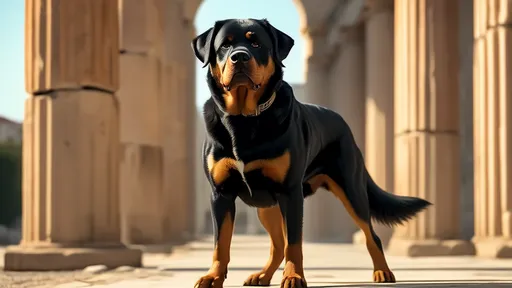
Looking at the modern Rottweiler, one sees the living culmination of its entire history. Its broad head and powerful jaws are a direct inheritance from its mastiff-type Roman ancestors. Its strong, compact body and deep chest speak to the endurance required for those long drives to market. The intelligence in its dark eyes reflects the cunning needed to manage a stubborn herd and the adaptability to learn complex modern tasks. And its famous black-and-tan markings serve as a timeless badge of its heritage. The journey from the dust of Roman roads to the family home is a testament to the breed's incredible resilience and enduring value. It is a dog shaped by empire, commerce, industry, and war, forever bearing the legacy of its past in its every movement and instinct.
Today, the future of the Rottweiler hinges on a conscious and responsible return to its core identity. Dedicated breeders, clubs, and owners worldwide are increasingly focused on preserving the breed's health, structural soundness, and, most critically, its stable, confident temperament. The goal is not to create a caricature of toughness, but to nurture the true, balanced character of the Rottweiler—a courageous guardian, an eager worker, and a devoted companion. This commitment ensures that the ancient spirit of the Roman drover dog, the steadfast Butcher's Dog of Rottweil, will continue to thrive for centuries to come, a powerful link between a distant past and a dynamic future.
By /Aug 20, 2025

By /Aug 20, 2025

By /Aug 20, 2025

By /Aug 20, 2025

By /Aug 20, 2025
By /Aug 20, 2025

By /Aug 20, 2025
By /Aug 20, 2025
By /Aug 20, 2025
By /Aug 20, 2025
By /Aug 20, 2025
By /Aug 20, 2025

By /Aug 20, 2025
By /Aug 20, 2025

By /Aug 20, 2025

By /Aug 20, 2025

By /Aug 20, 2025

By /Aug 20, 2025

By /Aug 20, 2025
By /Aug 20, 2025
