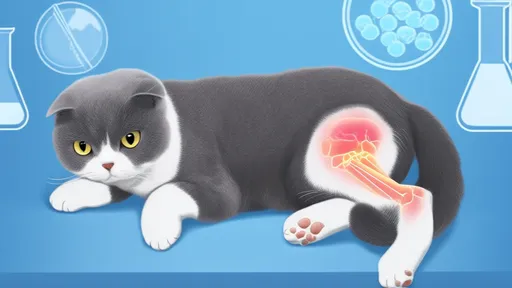
Scottish Fold cats are beloved for their distinctive folded ears, a trait that gives them an endearing, owl-like appearance. This unique feature, however, comes with a profound and often heartbreaking genetic cost. The very gene responsible for the charming fold is also the cause of a debilitating and painful lifelong condition known as Osteochondrodysplasia, often abbreviated as OCD. This is not a minor ailment but a fundamental disorder of the development of bone and cartilage that affects the cat's entire skeletal system, leading to a lifetime of potential suffering.
The story of the Scottish Fold begins in 1961 on a farm in Perthshire, Scotland, with a white barn cat named Susie who possessed unusual folded ears. A neighboring farmer, William Ross, recognized her uniqueness and upon acquiring one of her kittens, began a breeding program. The trait was found to be dominant, meaning only one parent needed to possess the folded ear gene to pass the trait on to offspring. This discovery led to the rapid development of the breed, which was officially recognized in the mid-1970s. However, concerns about associated health problems emerged almost immediately. Early breeders noticed that these cats often developed stiff, painful joints and abnormal bone growth, issues that were inextricably linked to the desired ear cartilage deformity.
The root of the problem lies in a single autosomal dominant gene mutation, specifically identified as a mutation in the TRPV4 gene. This gene plays a crucial role in regulating the development and maintenance of cartilage throughout the body. In a healthy cat, cartilage serves as a flexible template for bone growth and provides smooth, cushioning surfaces in joints. The mutated TRPV4 gene disrupts this process. It causes a defect in the production and organization of collagen and other structural components within the cartilage, preventing it from developing with normal strength and elasticity. This faulty cartilage is weak and fails to provide adequate support, leading to the widespread skeletal abnormalities characteristic of the disorder.
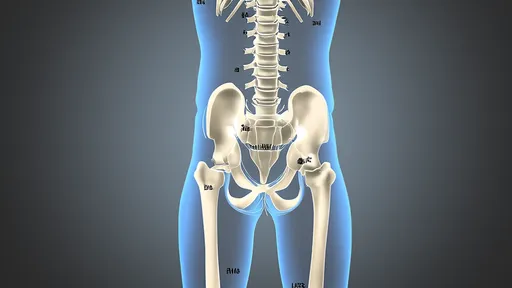
The most visible manifestation of this genetic error is, of course, the folded ears. Unlike the erect ears of a typical cat, which are supported by robust and resilient cartilage, the ears of a Scottish Fold are floppy because their cartilage is too soft and weak to hold them upright. This is merely the tip of the iceberg. The same defective cartilage development occurs in all the weight-bearing joints of the body, including the elbows, wrists, ankles, knees, and most severely, the spine and tail. The weak cartilage in these joints deteriorates prematurely, failing to cushion the bones properly. This leads to a cascade of problems: abnormal bone formation, exostoses (bony spurs), joint fusion, and severe, degenerative osteoarthritis, often in cats as young as a few months old.
For an affected cat, daily life is a challenge defined by pain. The clinical signs of Osteochondrodysplasia are a direct reflection of this chronic discomfort and physical deformity. Owners may observe a pronounced reluctance to move, jump, or play—behaviors often mistakenly attributed to a calm or "lazy" temperament. The cat's gait is typically abnormal; it may appear stiff, stilted, or lame, and it might avoid using a particular limb altogether. The tail is often thick, inflexible, and shortened due to fused vertebrae, making it painful or impossible to swish or lift. As the disease progresses, cats may sit in an unusual "Buddha position" with their hind legs splayed out, attempting to relieve pressure on their painful joints. Any attempt to handle or pet the cat, especially around the legs, tail, or lower back, may elicit a painful reaction such as a hiss, bite, or cry.
Diagnosing this condition involves a multi-faceted approach. A veterinarian will start with a thorough physical examination, palpating the joints and tail for swelling, reduced range of motion, and signs of pain. However, the definitive diagnosis comes from radiographic imaging—X-rays. The X-rays of an affected Scottish Fold are strikingly abnormal. They reveal a landscape of severe joint irregularities: narrowed joint spaces, misshapen and enlarged bone ends, the presence of new bone growth around joints (periarticular proliferation), and a general lack of the clear, sharp definition seen in healthy joints. In advanced cases, the bones of the feet, called phalanges, may appear distorted and lumpy. These radiographic findings are pathognomonic, meaning they are uniquely characteristic of this specific disease.
It is a critical and often misunderstood point of genetics that every single Scottish Fold cat, by virtue of possessing the folded-ear phenotype, has some degree of Osteochondrodysplasia. The mutation is incompletely dominant, and its expression can vary in severity. Some cats may be mildly affected and manage reasonably well for years, while others are severely crippled from kittenhood. There is no such thing as a "healthy" folded-ear cat; there are only cats whose pain is being managed and those whose pain is not. The ethical dilemma for breeders and prospective owners is immense. Breeding two folded-ear cats together produces offspring that are almost universally severely affected, a practice now widely condemned. Most responsible breeders pair a folded-ear cat with a straight-eared cat (typically a British or American Shorthair, which are not carriers of the mutation). This pairing produces a litter in which approximately half the kittens will have folded ears and the associated OCD, and half will have straight ears and be free of the skeletal disease.
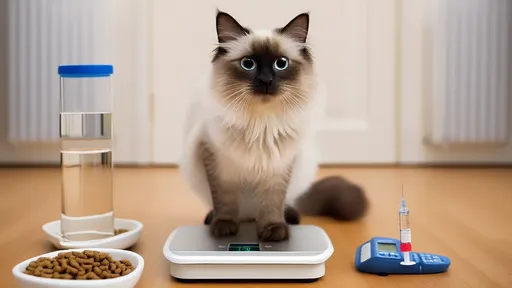
When it comes to treatment, the harsh reality is that there is no cure for Osteochondrodysplasia. The genetic defect is present from conception, and the skeletal abnormalities are permanent. Therefore, all management strategies are palliative, aimed solely at controlling pain, reducing inflammation, and improving the quality of life for as long as possible. This typically involves a lifelong regimen of veterinary-prescribed non-steroidal anti-inflammatory drugs (NSAIDs) and other pain medications like gabapentin. supplements such as glucosamine and chondroitin, or omega-3 fatty acids, may provide some support for joint health but cannot reverse the damage. Weight management is absolutely paramount, as any excess weight places catastrophic strain on the already compromised joints. Providing a comfortable environment with easy access to food, water, and litter boxes, along with soft, warm bedding, is essential. In some extreme cases of limb deformity, surgical interventions like ostectomies (removal of a bone segment) or arthrodesis (joint fusion) may be attempted to alleviate a specific source of pain, but these are major procedures with significant recovery periods.
The existence of the Scottish Fold breed sits at a contentious crossroads of aesthetics and ethics. Many animal welfare organizations, veterinarians, and feline geneticists argue that deliberately breeding animals for a trait that causes inherent suffering is unethical. This has led to the breed being banned from registration by several major cat registries, including the Governing Council of the Cat Fancy (GCCF) in the UK, the very country of its origin. The debate forces a difficult question upon the pet-loving public: is our desire for a uniquely cute companion justified if it condemns that companion to a life of potential pain? For those who already share their homes with a Scottish Fold, the commitment is to vigilant, compassionate, and lifelong care. For those considering bringing one into their family, the most ethical choice is often to admire their unique beauty from afar and instead offer a home to one of the countless healthy cats in shelters waiting for a second chance, free from the burden of a painful genetic legacy.
By /Aug 20, 2025
By /Aug 20, 2025
By /Aug 20, 2025
By /Aug 20, 2025
By /Aug 20, 2025
By /Aug 20, 2025
By /Aug 20, 2025
By /Aug 20, 2025
By /Aug 20, 2025
By /Aug 20, 2025
By /Aug 20, 2025
By /Aug 20, 2025
By /Aug 20, 2025
By /Aug 20, 2025
By /Aug 20, 2025
By /Aug 20, 2025
By /Aug 20, 2025
By /Aug 20, 2025
By /Aug 20, 2025
By /Aug 20, 2025
